

SAALT Documentation
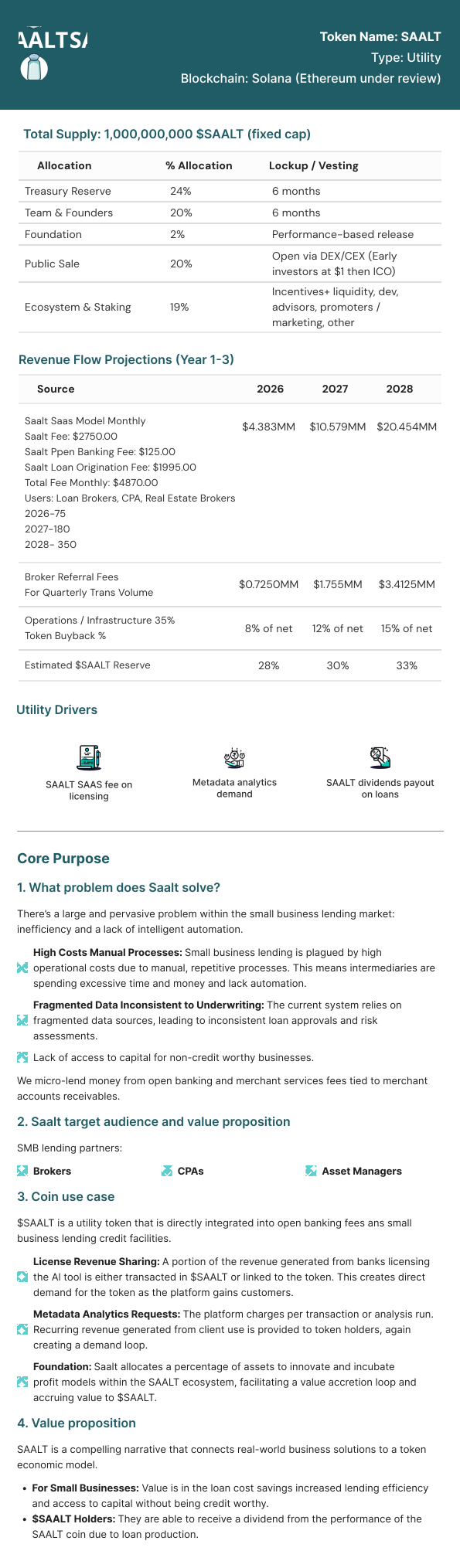


SAALT Flyer

Saalt Legal Advisory Clause – Crypto Regulatory Measures
The Company acknowledges and agrees that all activities involving digital assets, blockchain technology, token issuance, exchange operations, or related services are subject to evolving local, state, federal, and international laws and regulatory frameworks. Nothing contained in this Agreement shall be construed as legal, financial, or compliance advice. Each Party is solely responsible for ensuring its own compliance with all applicable laws, including but not limited to securities regulations, anti-money laundering (AML) requirements, know-your-customer (KYC) obligations, tax reporting rules, consumer protection statutes, and any other regulatory directives governing the use, transfer, or custody of digital assets.
Saalt makes no guarantees regarding the legal status of any digital asset or transaction under current or future regulations. All Parties acknowledge that regulatory positions may change rapidly and that such changes may materially impact the operation, value, legality, or viability of digital asset-related products or services. Each Party agrees to consult with qualified legal counsel prior to engaging in any activity related to blockchain or digital assets and assumes full responsibility for all legal and regulatory risks arising from such activities.
Crypto Compliance Policy Set
Customized for Saalt Technologies Inc.
Saalt Technologies Inc. (“Saalt”, “Saalt Technologies Inc.”, “we”, “our”) operates digital asset and blockchain-based services. The following policies are tailored to reflect Saalt’s operations as a U.S.-based crypto technology and platform services company. These policies establish Saalt’s legal, regulatory, and operational compliance framework.
This document contains a complete set of core compliance policies for crypto-related websites, including exchanges, wallets, token issuers, and DeFi platforms. You may customize each section to match your specific business model and jurisdiction.
1. Terms & Conditions
1.1 Introduction
These Terms & Conditions (“Terms”) govern your use of the Platform, including all products, services, and tools provided. By accessing the Platform, you agree to be bound by these Terms.
1.2 Eligibility
Users must be at least 18 years old and legally permitted to engage in cryptocurrency transactions in their jurisdiction.
1.3 Account Registration
Users agree to provide accurate information and maintain the security of their account credentials.
1.4 Prohibited Activities
Money laundering, terrorist financing, or illegal transactions.
Abuse of the platform, including fraud or exploitation.
Use of bots, automation, or market manipulation.
1.5 Platform Availability
The Platform may experience downtime due to maintenance or unforeseen events. The Company assumes no liability for interruption of services.
1.6 Limitation of Liability
The Company is not liable for losses due to volatility, hacks, technical errors, or market changes.
1.7 Termination
The Company may suspend or terminate accounts that violate these Terms.
2. Privacy Policy
2.1 Data Collection
We collect personal information such as name, email, identification documents, IP address, and transaction history.
2.2 Use of Data
Data is used for:
KYC/AML verification
Transaction processing
Platform analytics and improvements
Legal compliance
2.3 Data Sharing
We may share data with regulators, compliance partners, and service providers.
2.4 User Rights
Users may request access, correction, or deletion of their data as permitted by law.
2.5 Data Security
We implement encryption, access controls, and regular audits.
3. KYC/AML Compliance Policy
3.1 Purpose
This policy ensures compliance with global Anti-Money Laundering (AML) and Counter-Terrorist Financing (CTF) regulations.
3.2 Customer Identification Program (CIP)
Users must submit:
Government-issued ID
Proof of address
Liveness or biometric verification
3.3 Risk Assessment
Users are categorized as low, medium, or high risk based on geographic, transaction, and behavioral factors.
3.4 Monitoring & Reporting
We utilize blockchain analytics and transaction monitoring tools. Suspicious activity is reported to the appropriate authorities.
3.5 Recordkeeping
KYC and transaction records are retained for a minimum of 5–7 years.
4. Risk Disclosure Statement
Cryptocurrency trading involves substantial risk, including:
Extreme price volatility
Permanent loss of funds
Cybersecurity risks
Regulatory changes
Smart contract vulnerabilities
Users acknowledge they understand these risks and are solely responsible for their decisions.
5. Security Policy
5.1 Infrastructure Security
SSL/TLS encryption
Firewalls and intrusion detection
Secure server architecture
5.2 User Account Security
Multi-factor authentication
Password encryption
Session monitoring
5.3 Asset Security (If Custodial)
Cold storage for most digital assets
Multi-signature authorization
Regular audits
5.4 Incident Response
We maintain an incident response process including detection, investigation, notification, and remediation.
6. Cookie Policy
The Platform uses cookies for:
Authentication
Analytics
User preference storage
Users may opt out of non-essential cookies.
7. Token Legal Disclaimer (If Applicable)
7.1 No Investment Advice
Tokens are not investment products. Nothing on the Platform constitutes financial advice.
7.2 No Guaranteed Returns
We do not guarantee future value, profit, or appreciation.
7.3 Utility Description
Provide a clear explanation of the token’s utility, access rights, and ecosystem involvement.
7.4 Jurisdictional Restrictions
Users from restricted or sanctioned jurisdictions may not participate.
8. Marketing & Advertising Compliance Policy
8.1 Fair Marketing Standards
All statements must be accurate, non-misleading, and clearly supported.
8.2 Influencer & Affiliate Requirements
Affiliates must disclose paid promotions.
8.3 Regulatory Advertising Rules
We comply with advertising standards set by:
Google Crypto Certification
Meta Crypto Advertising Policy
Regional regulators
9. Smart Contract & DeFi Compliance Policy
9.1 Audit Requirements
All smart contracts must undergo third-party security audits.
9.2 Admin Key Disclosure
Disclose control mechanisms, upgradeability, and governance rights.
9.3 Bug Bounty Program
Encourage responsible vulnerability disclosure.
9.4 DeFi User Risks
Smart contracts may fail, be hacked, or experience oracle failures.
10. Internal Compliance Procedures
10.1 Employee Training
All staff must receive annual compliance and AML training.
10.2 Vendor & Partner Due Diligence
We review operational, cybersecurity, and compliance integrity of external service providers.
10.3 Regulatory Reporting
We maintain logs for audit trails and regulatory reporting.
10.4 Policy Reviews
Policies are reviewed and updated annually or when regulations change.
Saalt Legal Opinion

- Web: www.kiramaevska.legal
- Email: [email protected]
- Telegram / Twitter: @kiramaevska
Legal Opinion
on the matter of the applicability of securities regulations to the SAALT token
13 April 2026
1. Issues to be analysed
The following issues have been posed for the analysis:
- Analysis of characteristics and token model of the SAALT token distributed by SAALT
Technologies Ltd.; - Would the SAALT token fall in the category of security at the EU-wide level (we do not
analyse the legislation of each member state of the EU), the USA and Australia?
Expected result: a file with a designation of conclusions on the questions.
In this legal opinion, we do not analyse separately each EU-member state, rather, we analyse EU wide regulations and provide a general framework for the EU region.
2. Definitions
Analysis – this conclusion on the results of legal examination;
Company – SAALT Technologies Ltd., a limited company registered in the USA, having its address at 77 Sleeper St, Boston, MA, USA;
Legal Advisor – Guy Maevsky (aka Kira Maevska), lawyer, Reg. No. 345626977 of Georgia;
Token – SAALT token distributed by the Company and issued by the decentralised smart contract.
3. Goals and Objectives. Model Clauses
This Analysis includes the results of a legal examination, carried out by the Legal Advisor, with
respect to the questions posed for analysis. The Analysis is based on the SAALT Whitepaper
(“Whitepaper”), SAALT documentation available via the link: https://saaltfb.com/documentations/
(“Documentation”), related documents and information provided to the Legal Advisor by the
Company.
In agreeing on the task, there was no guarantee from the Legal Advisor’s side that the results of this
analysis would state the absence of risks and/or in all cases, methods would be proposed that
eliminate these risks or make them minimal.
Analysis of the current legislation and draft laws has been accomplished as is on the day of 13 April
2026. Please bear in mind that the legislation may be changed to the moment the results of the
analysis are being used.
Information used in the analysis was gathered from open sources, an own interpretation of the law
was used in a number of cases, since the novelty of legislation concerning the crypto assets sphere,
a number of legal relations have not been regulated.
This analysis includes only the analysis of the advanced issues and does not include the analysis of
revenue consequences of the business models being reviewed, as well as the relations with the
services consumers, tax regulations, relations with the banks and bank regulatory authorities.
The Company understands that legal advice provided herein does not guarantee success nor does it
guarantee immunity from civil and/or criminal prosecution due in part to the evolving nature of the
crypto assets and crypto assets services industry.
The Company is advised to consult with the Legal Advisor often, as the legal landscape is changing
and being updated, voted on, or challenged often by various competing forces at this time.
4. Input data
The SAALT project operates as a blockchain-integrated financial technology platform designed to
streamline and secure the operations of small and medium-sized businesses, technology providers
and third-party application networks. Under the governing documentation, the business model is
defined strictly as the provision of a hybrid software infrastructure rather than direct financial
lending. The SAALT ecosystem functions by connecting business bank accounts and accounting
software and merchant payment platforms directly to an artificial intelligence underwriting engine.
The native digital asset of the ecosystem is the $SAALT Token, which is planned to be minted on
the Solana blockchain utilising the SPL token standard and a proof-of-stake consensus mechanism.
The issuer has established a fixed total supply of one billion Tokens. To fund the development and
rollout of the AI agent suite, the Company is conducting a public presale of these Tokens. The
Company explicitly defines the Token as a functional utility asset and legally disclaims it as a
financial instrument, stating that it does not represent equity, debt, a claim on the issuer or a right to
financial dividends.
The Token is designed solely to act as the digital access key and transactional medium for the
platform’s technological suite, exhibiting three primary utility functions:
- the Token powers a cryptographic software-as-a-service payment and access model. Users
and referral partners consume Tokens to pay for their monthly or annual software licences; - the Token acts as the direct unit of payment for computational resources. The proprietary AI
lender tools require processing power and metadata extraction, a micro-transaction of
$SAALT is consumed each time a user initiates a borrower evaluation, runs an open-banking
data pull or requests an AI-generated risk assessment to process the metadata; - the ecosystem utilises a tiered network access model where participants can commit Tokens
to assist in trust confirmation and unlock progressive functional utility.
The ecosystem also implements a tiered access model where network participants can commit
tokens to assist in trust confirmation and unlock progressive functional utility. Users committing
between ten million and fifty million tokens enter Tier 1, unlocking access to premium AI models,
advanced platform features and ambassador programme eligibility. Users committing between fifty
million and one hundred million tokens enter Tier 2, granting them higher service capacity limits
and the ability to facilitate larger loan offerings for other ecosystem participants. A “premium
committee”, designated as Tier 3, is available for users committing over one hundred million
Tokens. This highest tier provides early access to beta features and new ecosystem initiatives.
The Token introduces protocol governance, empowering active participants to guide the
ecosystem’s direction. Through a decentralised governance structure, such as a decentralised
autonomous organisation, high-tier Token holders are granted voting rights on ecosystem
development matters. The governance framework is designed to decentralise operational decision
making regarding the software suite itself, rather than granting holders any managerial control over
the Company.
5. Brief summary
European Union. We estimate that the Token is not likely to fall within the general regulatory
framework of financial instruments, specifically, transferable securities, units in collective investment undertakings and derivative instruments, on the EU level and within the majority of EU
member states adopted the EU general regulatory framework of named financial instruments. The
Token do not constitute an asset-referenced token or an electronic money token according to the EU
general regulatory framework.
USA. We determine that the Token is highly unlikely to be classified as a regulated financial
instrument. The Token successfully evades classification as an investment contract by defeating the
two prongs of the Howey Test. We find that purchasers lack a reasonable expectation of speculative
profits based on selected lock-up models and development plans, satisfying the Forman
consumptive use precedent.
The Token also avoids alternative securities classifications. It fails the Landreth Test as it confers
no corporate equity, dividend rights or corporate voting power. It defeats the Reves Test because it
acts as a forward-purchase of software licenses rather than a debt instrument promising repayment.
Australia. Under Australian law and the regulator’s guidance, the Token strongly avoids
classification as a regulated financial product. It does not constitute a managed investment scheme
as funds are not pooled to generate a financial return, rather, purchasers acquire a consumptive
software benefit. The planned DAO further negates the MIS criteria by shifting day-to-day
operational control to the community.
The Token successfully avoids regulation as a non-cash payment facility by operating strictly within
a closed-loop environment. By design, it functions exclusively as a single-payee voucher to pay the
central issuer for native software services and is legally and factually restricted from facilitating
third-party payments or settling debts. Finally, the Token entirely lacks the statutory hallmarks of
traditional Australian securities, as it offers no corporate equity (share), promises no debt repayment
(debenture), and is not pegged to external assets (derivative).
6. Detailed analysis
a. EU-level regulation
Conclusion
According to our analysis of the EU-level regulation and general legal framework of regulating
crypto assets having securities-like characteristics, we estimate that the Token is not likely to fall
within the general regulatory framework of financial instruments, specifically transferrable
securities, units in collective investment undertakings and derivative instruments, on the EU level
and within the majority of EU member states adopted EU general regulatory framework of named
financial instruments. The Token do not constitute an asset-referenced token or an electronic money
token according to the EU general regulatory framework.
Analysis
General Analysis
On 13 November 2017, the European Securities and Markets Authority (ESMA) issued the
Statement1 where ESMA noted that some tokens, but not all tokens automatically, may be
considered financial instruments and all activities connected with these tokens may constitute
regulated activity. ESMA did not provide any definite guidance on how to define whether a token
is a security under EU law or not. EU legal regulation does not have any analogue of the US Howey
test. In basics, EU securities legislation is quite complex due to two levels of regulation: the union
level and the national level. That means that applicable regulation approaches may vary from state
to state.
In order to bring certainty to crypto assets, the European Commission adopted Regulation on
Markets in Crypto-assets (MiCA Regulation)2. MiCA Regulation sets missing regulations for utility
tokens and asset-referenced coins as well as sets requirements for such tokens’ distribution.
Security-like tokens still remain within the securities framework and are not additionally regulated
by MiCA Regulation.
Crypto assets should be analysed through the perspective of the general EU legislation covering
financial instruments and financial markets that is represented by the EU Directive on markets in
financial instruments (MiFID II)3.
Analysis of the applicability of the transferable securities category
It is important to outline that MiFID II does not provide a definition of “securities” generally. By
analysing MiFID II, we can come to the conclusion that the class of transferable securities is the
closest class of financial instruments in the EU to classify security tokens, the same opinion is shared
by ESMA in its Advice on Initial Coin Offerings and Crypto-Assets4.
According to our knowledge of national legislation of EU members, most of the EU-member
countries implemented the definition of transferable security in a scope similar to the MiFID II
Directive scope. This European harmonisation regulation takes supremacy in the hierarchy of
sources and requires national authorities to avoid regulatory additions and to exercise their powers
in harmony with European provisions.
According to MiFID II, transferable securities are those classes of securities which are negotiable
on the capital market, with the exception of instruments of payment, such as:
shares in companies and other securities equivalent to shares in companies, partnerships or
other entities, and depositary receipts in respect of shares;
bonds or other forms of securitised debt, including depositary receipts in respect of such
securities;
any other securities giving the right to acquire or sell any such transferable securities or
giving rise to a cash settlement determined by reference to transferable securities,
currencies, interest rates or yields, commodities or other indices or measures.
In order to fall under this definition, the crypto asset should be “negotiable on the capital market”.
There is no approach set by any administrative guidance on the general EU level in order to
determine what is considered as negotiable on the capital market with specific relation to crypto and
crypto exchange activities. According to the already mentioned Advice on Initial Coin Offerings
and Crypto-Assets issued by ESMA, most EU-member states interpret negotiability as the potential
transferability or tradability of crypto assets, however, it is not set in legislation, rather it is the
opinion of regulators.
MiCA Regulation does not add additional rules on whether a token is negotiable on the capital
market. MiCA Regulation sets rules for whitepapers of crypto assets and requires issuers to disclose
that crypto assets may not always be transferable.
When analysing the Token and its model, we come to the conclusion that the Token will become
transferable from the day of its unlock to the purchasers (depending on the sale events).
When we analyse the Token’s tradability, we check the availability and the Company’s plans to
make the Token available on the secondary market as well as the easiness of transfer of Tokens
between parties. At the moment of making this Analysis, the Token is not listed neither at centralised
or decentralised crypto exchanges. Listing the Token at a centralised exchange and/or at a
decentralised exchange protocol allows any third party to purchase and sell Tokens. We consider
that the Token only becomes tradable upon listing on a crypto exchange. At the moment of making
this Analysis, the Token is not tradable.
However, a crypto asset should not only be negotiable on the capital market itself, but rather it
should have characteristics of a transferable security.
By analysing the definition of transferable securities, we come to the conclusion that the following
types of tokens may be considered transferable security: i) equity-like token, ii) debt-like token.
MiFID II and ESMA did not set any additional requirements or broad interpretation of the
transferable security definition similar to the Howey test (applied in the United States jurisdiction)
and its broad interpretation by the US SEC and its FinHub5.
The Token does not represent rights to any types of shares or stock in any company, partnership or
entity and does not have any classic characteristics of equity, the Token does not grant to its
purchasers and holders any typical rights of shares or stocks, including the right to receive dividends
from the Company or to receive a part of the Company’s profits or revenues, right to participate in
the Company’s share capital, right to participate in the distribution of the Company’s surplus assets
upon winding up of the Company, right to request allocation of any Company’s property or assets
in a return for Tokens. The holders of Tokens do not have the right to inspect Company’s corporate
books and records, to participate in Company’s shareholders meetings and to inspect the Company’s
minutes of shareholders meetings.
The ecosystem implements a tiered access model where project participants can commit or stake
Tokens to assist in trust confirmation and unlock progressive functional utility. Based on the tier
threshold, Token holders unlock premium AI models, advanced platform features, higher service
capacity limits and the ability to facilitate larger loan offerings for other ecosystem participants.
This staking mechanism also functions as a requisite security deposit to safeguard the SAALT’s
proprietary technology and mandate responsible governance. High-tier Token stakers are granted
early access to undisclosed beta features and new ecosystem initiatives, their staked Tokens act as
collateral against malicious or irresponsible activity. Should a user abuse these advanced privileges,
such as by executing the unauthorised public disclosure of confidential platform mechanics or
engaging in highly detrimental governance practices, the project implements a punitive confiscation
mechanism. Conceptually similar to the “slashing” mechanic utilised in Proof-of-Stake consensus
models, but executed natively at the application and governance layer, this allows the ecosystem to
revoke or burn the abusive user’s staked Tokens. This punitive structure inherently deters bad actors
and strictly enforces compliance with the project’s operational standards.
Furthermore, the economic rationale underpinning this staking mechanism is driven by functional
network necessity and operational efficiency rather than speculative financial yield. Because the AI
infrastructure relies on heavy, resource-intensive computational requests, staking serves as a vital
bandwidth allocation. By requiring a verifiable commitment of Tokens for trust confirmation, the
network effectively filters out malicious actors and prevents network congestion caused by
fraudulent requests. As was indicated by the Company, Token holders who stake higher amounts
will receive guaranteed bandwidth, lower latency and higher service capacity during periods of peak
network congestion.
For decentralised governance to function safely, voting rights must be placed in the hands of active,
long-term users rather than short-term market speculators. Staking acts as a verifiable metric of a
holder’s commitment to the SAALT ecosystem. By restricting governance capabilities (such as
voting on new AI models, platform upgrades or parameter changes) to those who have staked their
Tokens, the Company ensures that the technological roadmap is directed exclusively by the
enterprises and partners whose daily business operations depend on the ecosystem’s success.
It is imperative to establish from a regulatory perspective that the staking mechanism embedded
within the SAALT ecosystem is fundamentally devoid of any speculative nature. Unlike traditional
financial investment contracts wherein purchasers passively commit capital with an expectation of
monetary return driven by secondary market dynamics or the entrepreneurial efforts of a central
issuer, staking the Token is an active, operational prerequisite. As established in the project’s d
Documentation, the primary function of committing Tokens to the network is to facilitate trust
confirmation and to unlock progressive functional utility within the ecosystem. Network
participants stake tokens strictly to access higher service capacity limits, secure computational
bandwidth for proprietary artificial intelligence lender tools and obtain premium application
programming interface rate limits. The mechanism is conceptualised entirely around software
architecture and resource management rather than capital appreciation.
Consequently, the economic rationale underpinning this staking architecture is rooted in commercial
utility rather than financial speculation. The ecosystem ensures that incentives are inextricably
linked to the user’s active consumption of the SAALT project and their strict adherence to
operational standards. Because the Company is under no obligation to distribute ecosystem fees
solely based on the status of passive token ownership, there is no legal correlation between the act
of staking and the generation of speculative financial yield.
Participants who stake Tokens must assume a continuous, active role in maintaining data integrity
and engaging in responsible ecosystem governance. The staked Tokens act as a requisite security
deposit or digital surety bond. Should a user engage in malicious activity, submit fraudulent open
banking data or abuse early-access features, their staked tokens are subject to a punitive confiscation
mechanism executed at the application layer. This exposure to operational penalty requires
participants to act with persistent diligence, thereby thoroughly negating the passive expectation of
profit derived primarily from the efforts of others, which is a core tenet of identifying speculative
securities.
Ultimately, the staking architecture serves as a necessary technological safeguard against ecosystem
spam and resource depletion, ensuring that the heavy computational demands of real-time
underwriting and predictive analytics are sustainably coordinated. Therefore, the act of staking
Tokens is exclusively a functional software management tool. It provides tangible, commercial
sense for active platform users seeking guaranteed technological performance and remains entirely
distinct from speculative financial enterprises designed to generate rapid monetary returns for
passive holders.
The Token holders do not have intrinsic rights to claim financial returns and the Company is under
no obligation to distribute any part of its pre-allocated Tokens or project fees solely based on the
status of Token ownership. Receiving any potential staking yields or rewards depends entirely on
product adoption, network conditions and the active commitment of tokens to the network, which
may be changed, reduced or cancelled at the Company’s sole discretion.
According to the Token model adopted by the Company, the Token will not grant its holders rights
to vote on the corporate governance, corporate business strategy, corporate revenues and financials
or any other matters related to the entity. As was explained to the Legal Advisor by the Company
the Token model would provide Token holders rights to suggest and vote on matters connected with
the development and the evolution of the ecosystem and only upon reaching decentralisation of such
ecosystem.
In our opinion, the introduced rewards program does not bring either shares (stocks) or debenture
characteristics to the Token, and it does not bring the right to Token holders to receive any part of
the Company’s revenues. A reward for the provision of liquidity to the ecosystem is not a payment
of interest to Token holders and it is not a repayment of Tokens purchase.
No Token holders would be partners for any kind of joint venture and none of the Token holders
would be authorised to act on behalf of or make any decisions binding the Company or a community
of Token holders.
In our opinion, the Token is not likely to fall within the category of transferable security on the EU
wide level due to the absence of classic equity-like or debt-like features, however, it may fall into
national regulation of EU members if country-specific regulation would be adopted.
Analysis of the applicability of the category of units in collective investment undertakings
The second thing to be analysed for the EU region is the other relevant types of financial instruments
set by MiFID II: units in collective investment undertakings and derivative instruments.
In order to define a collective investment undertaking, MiFID II refers to the EU Directive on the
coordination of laws, regulations and administrative provisions relating to undertakings for
collective investment in transferable securities (UCITS)6, that in its turn sets the definition of an
undertaking for collective investment in transferable securities (UCITS) that means an undertaking with the sole object of collective investment in transferable securities or in other liquid financial
assets, financial derivative instruments, units in UCITS or money-market instruments and which
operate on the principle of risk-spreading; and with units which are, at the request of holders,
repurchased or redeemed, directly or indirectly, out of those undertakings’ assets.
The Company specifically confirmed to the Legal Advisor that the Company does not intend to
invest the proceeds from its Token sale in any transferable securities or other financial instruments
mentioned in the UCITS Directive, such as financial derivative instruments, units in UCITS or
money-market instruments. The Company specifically confirmed that it does not intend to take any
actions to influence the market price of Tokens.
There are no promises in the Documentation and the public communication of the Company to pool,
invest pooled assets in any property and further distribute any profits (or part of profits) from such
investing to Token holders. Moreover, as was previously discussed in this Analysis the ecosystem
incentivises only holders’ contribution to the ecosystem, validating of transactions and maintaining
consensus over the ecosystem or participating in governance, meaning that no token holders per se
are entitled to incentives, rather they would need to perform actions in order to become eligible to
such incentives.
Additionally, Token holders do not acquire any economic or legal claims over property or assets,
and the Token does not entitle holders to dividends, revenue, or profits. While tokens can be traded
on secondary markets, their primary purpose is to serve the function of a core asset of the protocol
and the ecosystem and be used for paying fees to the protocol and rewarding for the provision of
services to the protocol and the ecosystem. Token holders are not entitled to participate in the
distribution of the Company’s surplus assets in the event of its winding up. They also have no right
to request the allocation of any of the Company’s property or assets in exchange for their tokens
The proceeds from the sale of Tokens constitute the Company’s revenue. These funds will be
utilised by the Company for operational purposes, including but not limited to paying salaries to
team members and further developing the underlying software until its deployment and subsequent
decentralisation. It is important to note that the Company has not made any promises or
commitments to repurchase the Tokens from holders.
We consider that it is unlikely that the Company may be considered a UCITS under the UCITS
Directive, and Tokens are unlikely to represent units in a UCITS.
Analysis of the applicability of the category of derivative instruments
MiFID II sets the following types of derivative instruments: financial contracts for difference,
options, futures, swaps, forward rate agreements, any other derivative contracts relating to
securities, commodities, currencies, interest rates or yields, emission allowances or other
derivatives instruments, financial indices or financial measures, any other derivative contracts
relating to climatic variables, freight rates or inflation rates or other official economic statistics,
and any other derivative contracts relating to assets, rights, obligations, indices and measures.
A future means a contract to buy or sell a commodity or financial instrument on a designated future
date at a price agreed upon at the initiation of the contract by the buyer and seller. Every futures
contract has standard terms that dictate the minimum quantity and quality that can be bought or sold,
the smallest amount by which the price may change, delivery procedures, maturity date and other
characteristics related to the contract.
An option means a contract that gives the owner the right, but not the obligation, to buy (call) or sell
(put) a specific financial instrument or commodity at a predetermined price, strike or exercise price,
at or up to a certain future date or exercise date.
A swap means a contract in which two parties agree to exchange cash flows in one financial those
of another financial instrument at a certain future date.
A forward or a forward agreement means a private agreement between two parties to buy or sell a
commodity or financial instrument at a designated future date at a price agreed upon at the initiation
of the contract by the buyer and seller.
A financial contract for difference is a derivative product that gives the holder an economic right,
which can be long or short, to the difference between the price of an underlying asset at the start of
the contract and the price when the contract is closed.
Neither Token holders nor the Company or any third parties are subject to obligations similar to
specified above for the typical derivative contracts, and Token holders are not entitled to demand
from the Company any commodity or financial instrument to be sold to them, neither Token holders
are entitled to demand an exchange of cash flows in any financial instruments or a cash settlement
from any third party.
The value of the Token is not based on or relate to securities, commodities, currencies, interest rates
or yields, emission allowances or other derivatives instruments, financial indices or financial
measures, or any other assets, rights, obligations, indices and measures and is only determined based
on the current market demand for it, and the Token is not used to transfer credit risk.
We consider that it is unlikely that the Token would be considered as a derivative financial
instrument according to the provisions of MiFID II.
According to our analysis of EU-level regulation and the general legal framework of regulating
crypto assets having securities-like characteristics, we estimate that the Token is not likely to fall
within the general regulatory framework of financial instruments, specifically, transferrable
securities, units in collective investment undertakings and derivative instruments, on the EU level
and within the majority of EU member states adopted EU general regulatory framework of named
financial instruments.
Analysis of the applicability of the category of asset-referenced tokens or e-money tokens
MiCA introduces regulatory frameworks for stablecoins, specifically addressing two categories:
asset-referenced tokens and electronic money tokens.
An asset-referenced token means a type of crypto-asset that is not an electronic money token and
that purports to maintain a stable value by referencing another value or right or a combination
thereof, including one or more official currencies. And in its turn, an electronic money token (or e
money token) means a type of crypto-asset that purports to maintain a stable value by referencing
the value of one official currency.
Unlike asset-referenced tokens or e-money tokens, the Token does not maintain a stable value by
referencing fiat currencies, cryptocurrencies, a basket of assets, or other external benchmarks. Its
value is entirely independent of such references.
The price of the Token is intended to be determined solely by the dynamics of the secondary market.
There is no mechanism, algorithm or external stabilisation measure in place to artificially manage
or peg its price. The Token derives its value primarily from its utility within the project and
ecosystem. This includes roles such as paying for access to the software and AI transactions,
enabling governance participation and provision additional functionality for token holders. The lack
of any explicit or implicit commitment to maintain value stability further distinguishes the Token
from MiCA-regulated stablecoins.
The Token is not an asset-referenced token or an electronic money token under MiCA and is
therefore not subject to the specific regulatory requirements applied to stablecoins.
b. USA
Conclusion
Based on a comprehensive analysis of the Token’s architecture, tokenomics and operational rollout
plan against the United States federal securities framework, we determine that the Token is highly
unlikely to be classified as a regulated financial instrument. The core of this legal defence relies on
the demonstrable economic reality of the Token as a consumptive software utility rather than a
speculative investment vehicle.
While the Token presale constitutes an investment of money in a common enterprise, it successfully
defeats the final two prongs of the Howey Test. By implementing a reasonable lock-up period, the
issuer ensures that a purchaser’s primary motivation aligns with active consumption rather than
passive speculation. This non-speculative reality is further reinforced by the complete absence of
deflationary tokenomics or artificial price escalations.
Additionally, because basic platform functionality is already live and developmental risk is planned
to be absorbed entirely during the illiquid lock-up period, purchasers do not rely on the future
entrepreneurial efforts of the central team. The planned activation of a decentralised autonomous
organisation also permanently shifts essential ecosystem governance from the issuer to a dispersed
community of network users.
The Token also successfully evades alternative securities classifications. It negates the Landreth
Test as it exhibits no characteristics of traditional corporate equity, granting no fractional shares, corporate voting rights or rights to dividends. It defeats the Reves Test because it operates strictly
as a forward-purchase of computational bandwidth rather than a debt instrument, completely lacking
a creditor-debtor relationship, promise of principal protection or interest generation.
Therefore, provided that the Company strictly adheres to its operational roadmap, the Token
strongly avoids classification as a security.
Analysis
The legal classification of digital assets within the United States is governed by a complex matrix
of statutory frameworks, judicial precedents and administrative agency guidance.
The primary statutory authority governing the issuance and primary market sale of securities is the
Securities Act of 19337, which mandates the registration of any offer or sale of securities unless an
explicit exemption applies. Secondary market trading, the operation of exchanges, and the conduct
of broker-dealers are subsequently regulated by the Securities Exchange Act of 19348.
Furthermore, collective investment vehicles that pool capital to invest in securities fall under the
purview of the Investment Company Act of 19409, whilst entities providing investment advice are
regulated by the Investment Advisers Act of 1940.
Because these statutory frameworks were established decades before the advent of blockchain
technology, their application to digital assets relies heavily on established judicial precedent. The
foundational cornerstone for determining whether an instrument or transaction constitutes an
investment contract is the United States Supreme Court decision in Securities and Exchange
Commission v. W. J. Howey Co10.
Additional critical source of law includes Landreth Timber Co. v. Landreth11, which outlines the
characteristics of traditional equity, and United Housing Foundation, Inc. v. Forman12, which
establishes the legal distinction between purchasing an asset for speculative financial return versus
purchasing it for consumptive utility. Complementing this statutory and judicial bedrock is the
administrative guidance issued by regulatory bodies, most notably the Securities and Exchange
Commission.
The SEC’s FinHub has published its Framework for investment contract’s analysis, which provides
the internal methodology for applying the Howey Test to tokenised ecosystems. Additionally,
formal investigative reports, such as the SEC’s Report of Investigation regarding the DAO case,
serve as critical regulatory markers that legally equate cryptocurrency contributions to traditional
investments of money. Together, these statutes, court decisions and administrative guidelines form
the comprehensive legal landscape under which the Token must be evaluated.
Analysis as an Investment Contract (The Howey Test)
Howey case and subsequent case law have found that an “investment contract” exists when there is
the investment of money in a common enterprise with a reasonable expectation of profits to be
derived from the efforts of others. In order to meet the Howey Test, all four components (prongs)
shall be met. The test uses an “and” approach, not an “or” approach, where only one criterion should
be met. Even if three components are met but one component is not met, then the investment contract
will not exist, and the token will not be considered a security.
Investment of money
The SAALT project intends to distribute tokens to users and participants to fund ongoing operations
and ecosystem scaling. The SEC formally approaches payments made in cryptocurrencies as a
contribution of value that readily creates an investment contract under the first prong of the Howey
Test. Any distribution of tokens during public or private sales will undoubtedly be considered by
the SEC as an investment of money. Furthermore, if the project rewards users for staking or
providing liquidity and this reward is subject to taking specific actions, this is legally considered a
contribution of value.
Consequently, we consider this first component of the test to be fully satisfied.
Investment in a common enterprise
To satisfy the common enterprise aspect of the Howey Test, federal courts require the presence of
either horizontal commonality or vertical commonality. The SEC FinHub typically applies the
horizontal commonality approach, concluding that investments in digital assets constitute a common
enterprise because the fortunes of the digital asset purchasers are inextricably linked to each other
or directly tied to the success of the promoter’s efforts. Because the capital injected into the SAALT
ecosystem supports the overarching artificial intelligence underwriting infrastructure, the fortunes
of all token purchasers are linked to the successful execution and adoption of the project by the
central issuer.
Therefore, we consider this second prong as satisfied.
Reasonable expectation of profits
The primary point when analysing a token under the Howey Test is whether a purchaser possesses
a reasonable expectation of profits or other financial returns. Federal courts look directly to the
economic reality of the transaction. In doing so, the courts heavily consider whether the instrument
is offered and sold for immediate use or consumption by purchasers. According to the United
Housing Foundation, Inc. v. Forman case, where a purchaser is not attracted solely by the prospects
of a return on their investment but is motivated by a desire to use or consume the item purchased,
the securities laws do not apply.
The Company’s roadmap indicates that the core product is planned to be working in the second
quarter of 2026, coinciding with a public Token sale scheduled for the second or third quarter of the year. The Company has stated that a certain portion of Tokens purchased at the public sale will be
available to buyers almost immediately and the project intends to switch on the functionality to
accept these tokens exactly as they become available. Based on the governing documentation and
the Company’s confirmations regarding its software-as-a-service model, the $SAALT Token
exhibits the structural characteristics of a consumptive utility token.
Crucially, basic functionality of the platform is available right now, providing tangible evidence of
the project’s operational reality. Because this foundational infrastructure is already live, there is no
doubt that the necessary token-specific functionality will be introduced in a timely manner.
However, if the Token becomes available and tradable before the underlying software functionality
is active and capable of accepting the Tokens for their intended use, the asset faces a risk of being
classified as a security under United States law. While the timing of functional deployment is
important to establishing consumptive use, it is not self-determinative and still relates heavily to
purchaser expectations of getting profits. To definitively invoke the consumptive defence, the
SAALT project relies on a mandatory lock-up period that strictly prohibits token distribution until
the platform’s core utility is operable.
The Whitepaper explicitly establishes that the Token is offered as a non-investment product
designed exclusively for consumptive use within its software-as-a-service and artificial intelligence
ecosystem. To reinforce this non-speculative economic reality, the tokenomics model explicitly
avoids any mechanisms designed to artificially decrease the circulating supply, such as algorithmic
token burning or corporate buyback programmes. Furthermore, there are no planned structural
changes or artificial escalations in the Token pricing requirements for the progressive access tiers
and the ecosystem lacks any kind of obvious speculative signs.
Because the Token remains illiquid until the exact moment the application programming interfaces
and software licensing mechanisms are active, the purchaser’s primary motivation is forced by
design to align with the active consumption of the software suite. Digital assets with these types of
use or consumption characteristics are less likely to be investment contracts.
Unlike token models that rely on deflationary supply mechanics or explicitly promise healthy triple
digit returns to form an expectation of profits merely from holding the asset, the operational SAALT
model requires active, ongoing consumption. Because the economic rationale underpinning the
token is driven by functional network necessity and SaaS licensing rather than speculative financial
yield, SAALT successfully negates this third prong.
Derived from the efforts of others
The fourth prong of the Howey Test determines whether the anticipated value of the asset is to be
derived substantially from the entrepreneurial or managerial efforts of others, typically the promoter
or a central third party. According to the framework provided by the Securities and Exchange
Commission, an investment contract is highly likely to exist if purchasers reasonably expect an
issuer to carry out the undeniably significant managerial efforts which affect the failure or success
of the enterprise. In the context of the SAALT project, the Company plays a lead and central role in
the direction of the ongoing development of the network and the overarching artificial intelligence infrastructure. If purchasers were to acquire and hold the token while the network or the digital asset
is still in development and not fully functional, they would be relying entirely on the future
entrepreneurial efforts of this central team to deliver the promised utility.
The fact that basic platform functionality is already available right now substantially mitigates this
reliance, as it demonstrates that the basic technical foundation has already been executed. Because
this working foundation exists, there is no doubt that the necessary token-integration features will
be introduced timely. Furthermore, the mandatory Token lock-up architecture effectively severs any
remaining reliance on the future managerial efforts of the issuer. Because the delivery of the Token
is planned upon the deployment of the operational software, the developmental risk is absorbed
during the period when the tokens are legally inaccessible to the public. When the Tokens are finally
unlocked, the functionality is planned to be developed and to be operational. At the moment of
unlock, the Token’s utility is immediately dependent on organic market demand for the functioning
software services rather than the developmental promises of the central issuer.
Furthermore, the implementation of the planned decentralised autonomous organisation serves as a
structural guarantee against reliance on a central promoter. As outlined in the project’s framework,
protocol governance is inextricably tied to the Token’s tiered access model, empowering high-tier
participants to actively guide the project’s direction. The SEC FinHub Guidance explicitly
recognises that when essential tasks or responsibilities are performed and expected to be performed
by an unaffiliated, dispersed community of network users, rather than an issuer, the reliance on the
efforts of others is substantially diminished. By ensuring that the Token is only distributed into a
live, functional ecosystem where this planned governance is immediately started being
implemented, the Company relinquishes its central, managerial role over the project’s future
governance issues and updates.
This structural shift guarantees that the essential managerial tasks are aimed to be performed by the
community rather than a centralised entity, thereby negating the fourth prong of the Howey Test.
Analysis Under the Landreth Test (Traditional Equity)
Beyond the Howey Test, United States federal courts utilise the precedent established in Landreth
Timber Co. v. Landreth to determine whether an instrument should be classified as traditional stock
or equity. The Token decisively fails to meet the criteria for traditional equity. The Token does not
represent a share in the legal entity, nor does it grant rights to financial dividends contingent upon
an apportionment of corporate profits. Whilst high-tier Token holders are granted voting rights, this
governance is strictly limited to decentralised protocol development and emphatically does not
confer corporate voting rights over the Company. Therefore, the Token does not constitute
traditional equity under United States securities law.
Analysis of the Token as a Note or Debt Instrument (The Reves Test)
Beyond the Howey Test for investment contracts and the Landreth Test for traditional equity, United
States federal courts utilise the family resemblance test, established by the Supreme Court in Reves v. Ernst & Young13, to determine whether an instrument is categorised as a note and therefore a
security. The Securities Act of 1933 and the Securities Exchange Act of 1934 broadly include any
note within the definition of a security, subject to certain exceptions. The Reves Test begins with a
legal presumption that every note is a security, which can only be rebutted if the instrument bears a
strong family resemblance to a judicially established list of non-security notes, such as consumer
financing notes or short-term commercial paper. To evaluate this, courts examine four factors: the
motivations of the buyer and seller, the plan of distribution, the reasonable expectations of the
investing public, and whether an alternative regulatory scheme significantly reduces the risk of the
instrument.
When applying the Reves test to the Token, it is clear that the instrument does not function as a note
or debt obligation. A note fundamentally involves a promise by the issuer to repay a specified
principal sum, typically with interest, at a defined future date. The Company makes no promise of
repayment, interest generation or principal protection. The Token is designed and marketed
exclusively as a consumptive utility mechanism to access software services and pay for artificial
intelligence computational bandwidth. Furthermore, the economic reality of the transaction is a
forward-purchase of software licences, not a loan provided to the corporate entity. Because there is
no underlying debt obligation, creditor-debtor relationship, or promise of financial repayment, the
Token avoids classification as a note or debt security under the Reves framework.
c. Australia
Conclusion
The Token is highly unlikely to constitute a regulated financial product under Australian law. Its
legal defence relies on its economic reality as a consumptive utility commodity rather than a
speculative investment.
The Token evades classification as a managed investment scheme. A mandatory lock-up ensures
purchasers acquire the Token for immediate software consumption upon unlock, while the planned
decentralised autonomous organisation intends to transfer day-to-day protocol control to the
community. Additionally, it avoids regulation as a non-cash payment facility by operating strictly
within a closed-loop environment. It functions exclusively as a single-payee voucher for the issuer’s
software and is legally prohibited from facilitating third-party payments or settling debts. Finally,
the Token completely lacks the legal hallmarks of traditional securities, as it offers no corporate
equity or dividend rights, promises no debt repayment and is not pegged to external assets.
Ultimately, provided the Company maintains the lock-up period, enforces closed-loop payment
restrictions and ensures community governance remains non-binding on the corporate entity, the
distribution and operation of the Token shall not trigger financial services licensing or disclosure
obligations in Australia.
Analysis
In Australia, the legal classification and regulation of digital assets are governed primarily by the
Corporations Act 200114. The regulatory authority responsible for administering and enforcing this
legislation is the Australian Securities and Investments Commission (ASIC).
Unlike the United States, which relies heavily on judicial precedent (such as the Howey test),
Australia operates under a strict statutory definitions-based framework found in the Chapter 7 of the
Corporations Act. If a crypto-asset meets the definition of a “financial product”, it will trigger
financial services licence and disclosure obligations.
To clarify the application of this regime to digital assets, ASIC provided guidance in Information
Sheet 225: Digital assets: Financial products and services15. The regulator’s position is that there is
no single rule for determining whether a digital asset is a financial product. The assessment must be
grounded in substance rather than form. The Commission emphasises that even if a token considered
in isolation is not a financial product, it may become one if it is bundled with other services to form
a regulated overarching arrangement.
Analysis as a Managed Investment Scheme and Financial Investment
The most significant regulatory risk for utility tokens in Australia is classification as an interest in
a managed investment scheme (MIS), which is the functional equivalent of an investment contract
under the Howey Test. The section 9 of the Corporations Act defines MIS as an arrangement where
(1) people contribute money or money’s worth to acquire rights to benefits, (2) contributions are
pooled or used in a common enterprise to produce financial benefits or rights in property, and (3)
members do not have day-to-day control over the operation of the scheme.
Information Sheet No 225 warns that if a digital asset allows customers to receive a financial return
or benefit (e.g., through yield-bearing stablecoins or managed staking where pooled assets generate
returns), it is likely a financial investment or MIS.
If purchasers acquire the Token strictly to speculate on the rising value of the Token generated by
the Company’s development efforts, the Token may constitute an interest in an unregistered MIS,
making its distribution a severe breach of Australian law.
However, the SAALT project’s architectural rollout provides a strong defence against the “financial
benefit” requirement. A financial benefit is legally distinct from a consumptive benefit. Because the
Token implements a reasonable lock-up period with expectations that at the moment of unlock, the
core software and functionalities are active, purchasers cannot trade the token for a speculative
financial benefit during the developmental phase.
Upon unlock, the Token shall immediately act as a required functional utility: a unit of payment for
computational resources and software licenses. Under Australian law, purchasing a voucher, license or digital right to use a specific software service is considered purchasing a consumptive good or
service, not pooling funds for a financial benefit. Because basic platform functionality is already
live, mitigating completion risk and the Tokens are explicitly non-deflationary and non-speculative,
the economic reality aligns with the forward-purchase of software utility.
Upon the Token unlock, the project plans to start implementing a DAO. This governance framework
is inextricably tied to the Token’s tiered access model, empowering high-tier participants to actively
guide the project’s direction. By granting Token holders voting rights over critical operational
decisions, such as protocol development matters, new AI models, platform upgrades and parameter
changes, the arrangement vests genuine day-to-day operational control into the hands of the
community. This collective community governance heavily disrupts the third limb of the MIS
definition, demonstrating that the members will not have control over the scheme’s operations.
Provided the Token is exclusively marketed for its utility and not for capital appreciation, it strongly
avoids MIS classification.
Analysis as a Non-Cash Payment Facility
The Corporations Act defines a non-cash payment (NCP) facility as an arrangement through which
a person makes payments, or causes payments to be made, otherwise than by the physical delivery
of Australian or foreign currency.
If a client uses Tokens solely to pay the Company for access to its software or to run an AI risk
assessment, this generally resembles a voucher or a closed-loop internal payment system. Such
single-payee arrangements are typically exempt from NCP regulations. Crucially, to remain firmly
outside the NCP regulatory perimeter, Tokens shall not be accepted as a means of payment by
anyone other than their issuer. Furthermore, Tokens shall not be accepted or utilised as a means of
repayment of debts.
Provided the Token is strictly restricted by design so that it can only be consumed to pay the central
issuer for native software services and is structurally and both legally prohibited from and factually
restricted from being used to pay third parties or repay debts it successfully avoids classification as
a non-cash payment facility under Australian law.
Analysis as a Share or Debenture
The Corporations Act defines a share as an equity interest in a corporate body, typically carrying
voting rights on corporate governance and dividend rights and defines a debenture as a chose in
action, including an undertaking by a body to repay deposited money as a debt.
According to the Token model adopted by the Company, the Token will not grant its holders rights
to vote on the corporate governance, corporate business strategy, corporate revenues and financials
or any other matters related to the entity. As was explained to the Legal Advisor by the Company
the Token model would provide Token holders rights to suggest and vote on matters connected with
the development and the evolution of the ecosystem and only upon reaching decentralisation of such
ecosystem.
The Token does not meet this statutory definition. The Company does not accept funds as a loan or
deposit, nor does it make any undertaking or guarantee to repay the Token purchasers their principal
amount, with or without interest. The economic reality of the token sale is a forward-purchase of
digital access keys and computational bandwidth for the project’s technological suite, not the
issuance of corporate debt.
Therefore, the Token is neither a share nor a debenture.
Analysis as a Derivative
Under the Corporations Act, a derivative is broadly defined as an arrangement where the amount
payable or the value of the arrangement is derived from the value or amount of something else (the
underlying asset, rate, index, or commodity).
The Token is a standalone digital utility asset. Its value is determined organically by market supply
and demand based on its intrinsic utility within the SAALT software. It is not contractually pegged
to the performance of external fiat currencies, stock indices or interest rates, nor is it a contract to
exchange cash flows.
Therefore, the Token does not meet the statutory definition of a derivative.
Enclosure:
a. SAALT Whitepaper as of 13 April 2026 – on 9 pages.
13 April 2026
Guy Maevsky
(aka Kira Maevska)